 Stupid Potato
 Join Potato Plus
Storybook · read aloud · free
The Dog in the Manger, and More of Aesop's Fables
The dog in the manger who will not share the hay, the rooster who would rather have corn than a jewel, the bundle of sticks, and more of Aesop's fables.
The story
The whole classic text, as Belle reads it.
The Dog in the Manger.
A Dog asleep in a manger filled with hay, was awakened by the Cattle, which came in tired and hungry from working in the field. But the Dog would not let them get near the manger, and snarled and snapped as if it were filled with the best of meat and bones, all for himself.
The Cattle looked at the Dog in disgust. "How selfish he is!" said one. "He cannot eat the hay and yet he will not let us eat it who are so hungry for it!"
Now the farmer came in. When he saw how the Dog was acting, he seized a stick and drove him out of the stable with many a blow for his selfish behavior.
Do not grudge others what you cannot enjoy yourself.
The Cock and the Jewel.
A Cock was busily scratching and scraping about to find something to eat for himself and his family, when he happened to turn up a precious jewel that had been lost by its owner.
"Aha!" said the Cock. "No doubt you are very costly and he who lost you would give a great deal to find you. But as for me, I would choose a single grain of barleycorn before all the jewels in the world."
Precious things are without value to those who cannot prize them.
The Hare and his Ears.
The Lion had been badly hurt by the horns of a Goat, which he was eating. He was very angry to think that any animal that he chose for a meal, should be so brazen as to wear such dangerous things as horns to scratch him while he ate. So he commanded that all animals with horns should leave his domains within twenty-four hours.
The command struck terror among the beasts. All those who were so unfortunate as to have horns, began to pack up and move out. Even the Hare, who, as you know, has no horns and so had nothing to fear, passed a very restless night, dreaming awful dreams about the fearful Lion.
And when he came out of the warren in the early morning sunshine, and there saw the shadow cast by his long and pointed ears, a terrible fright seized him.
"Goodby, neighbor Cricket," he called. "I'm off. He will certainly make out that my ears are horns, no matter what I say."
Do not give your enemies the slightest reason to attack your reputation.
Your enemies will seize any excuse to attack you.
The Peacock.
The Peacock, they say, did not at first have the beautiful feathers in which he now takes so much pride. These, Juno, whose favorite he was, granted to him one day when he begged her for a train of feathers to distinguish him from the other birds. Then, decked in his finery, gleaming with emerald, gold, purple, and azure, he strutted proudly among the birds. All regarded him with envy.
Even the most beautiful pheasant could see that his beauty was surpassed.
Presently the Peacock saw an Eagle soaring high up in the blue sky and felt a desire to fly, as he had been accustomed to do. Lifting his wings he tried to rise from the ground. But the weight of his magnificent train held him down.
Instead of flying up to greet the first rays of the morning sun or to bathe in the rosy light among the floating clouds at sunset, he would have to walk the ground more encumbered and oppressed than any common barnyard fowl.
Do not sacrifice your freedom for the sake of pomp and show.
The Bundle of Sticks.
A certain Father had a family of Sons, who were forever quarreling among themselves. No words he could say did the least good, so he cast about in his mind for some very striking example that should make them see that discord would lead them to misfortune.
One day when the quarreling had been much more violent than usual and each of the Sons was moping in a surly manner, he asked one of them to bring him a bundle of sticks. Then handing the bundle to each of his Sons in turn he told them to try to break it. But although each one tried his best, none was able to do so.
The Father then untied the bundle and gave the sticks to his Sons to break one by one. This they did very easily.
"My Sons," said the Father, "do you not see how certain it is that if you agree with each other and help each other, it will be impossible for your enemies to injure you? But if you are divided among yourselves, you will be no stronger than a single stick in that bundle."
In unity is strength.
The end.
From The Aesop for Children (Aesop, with pictures by Milo Winter, 1919). The original text, in the public domain, from Project Gutenberg (eBook #19994).
More stories
The Lark and Her Young Ones, and More of Aesop's Fables
5 min · read by Luna
Two Travelers and a Bear, and More of Aesop's Fables
5 min · read by Merritt
Belling the Cat, and More of Aesop's Fables
5 min · read by Ocean
The Hare and the Tortoise, and More of Aesop's Fables
6 min · read by Ocean
The Fox Without a Tail, and More of Aesop's Fables
6 min · read by Ocean
The Boy Who Cried Wolf, and More of Aesop's Fables
8 min · read by Merritt
The Tale of Peter Rabbit
5 min · read by Clara
The Little Red Hen
1 min · read by Luna
Why the Bear Is Stumpy-Tailed
1 min · read by Ocean
The Story of a Fierce Bad Rabbit
1 min · read by Matilda
Sweet Porridge
1 min · read by Merritt
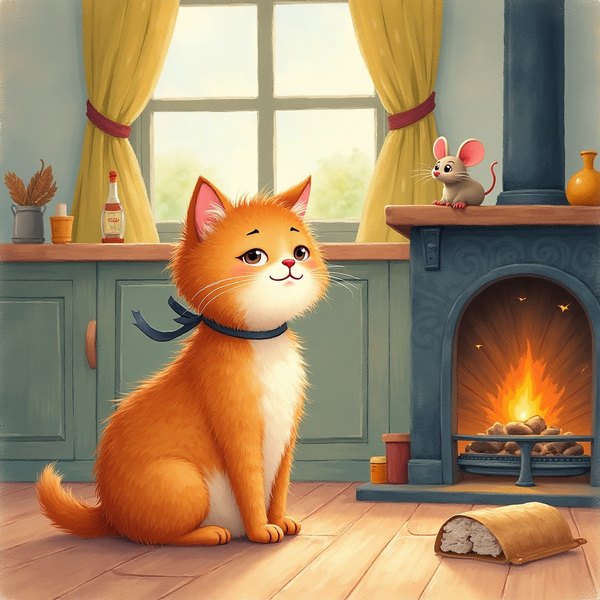
The Story of Miss Moppet
2 min · read by Cherry